
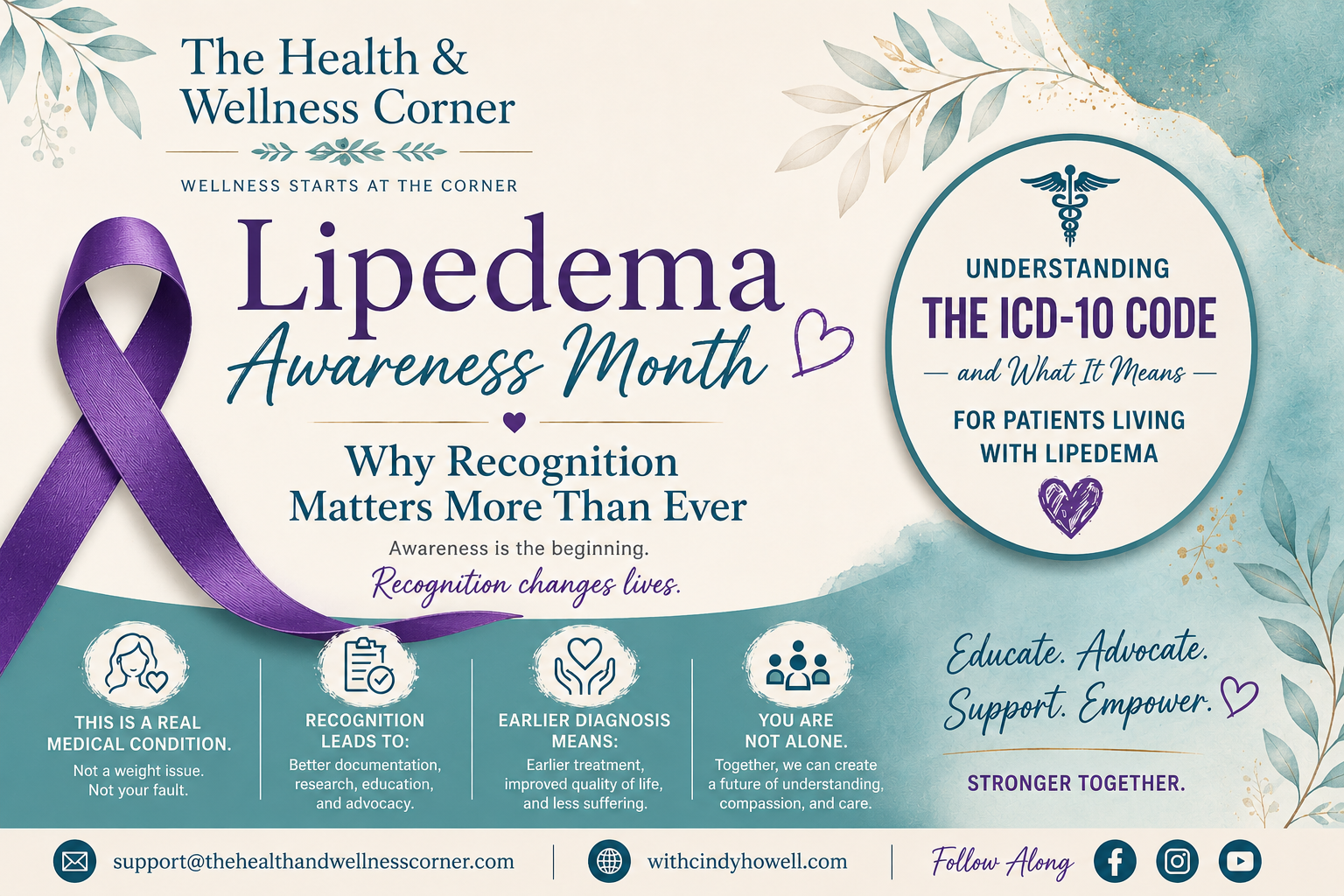
Every June, the lipedema community comes together to recognize Lipedema Awareness Month, a time to educate, advocate, and support the millions of women living with this often misunderstood disease.
For many women, receiving a diagnosis after years, or even decades, of being told to “just lose weight” is life-changing. A diagnosis validates what they have experienced all along: the pain, swelling, heaviness, easy bruising, and disproportionate fat distribution are real and are not caused by a lack of willpower.
Awareness is important, but recognition within the healthcare system is what truly changes lives.
What Is an ICD Code?
ICD stands for International Classification of Diseases. These codes are used worldwide by healthcare providers to document medical diagnoses. In the United States, ICD-10-CM codes are used for medical records, insurance claims, research, and healthcare reporting.
Having an accurate diagnosis code helps providers document a patient’s condition and can support communication between healthcare professionals. It also contributes to research by helping track how many people are living with a particular disease.
Where Does Lipedema Stand Today?
Although lipedema is increasingly recognized by healthcare professionals and researchers, the United States still does not have a disease-specific ICD-10-CM diagnosis code for lipedema.
Instead, providers often document lipedema using related codes such as:
- E88.2 – Lipomatosis, not elsewhere classified
- R60.9 – Edema, unspecified
- Additional codes may be used to document pain, swelling, lymphedema, or other symptoms when appropriate.
Internationally, however, progress has already been made. The World Health Organization’s ICD-11 includes a dedicated diagnosis code for lipedema (EF02.2), recognizing it as its own disease entity. While the United States has not yet adopted ICD-11 for clinical coding, this recognition represents an important milestone for the global lipedema community.
Why Does This Matter to Patients?
While an ICD code alone does not guarantee insurance coverage or treatment approval, recognition within medical coding is significant.
It helps:
- Improve documentation of lipedema as a distinct disease.
- Increase visibility in healthcare data and research.
- Support education of healthcare professionals.
- Strengthen future advocacy efforts.
- Lay the groundwork for improved access to medically necessary care.
Most importantly, it helps move lipedema further away from being misunderstood as simply obesity or lifestyle-related weight gain.
A Diagnosis Is More Than a Code
For many women, the greatest impact isn’t a billing code, it’s finally having an explanation.
Receiving a diagnosis often means:
- Understanding why diet and exercise alone never changed the affected areas.
- Finding healthcare providers who understand the disease.
- Learning effective conservative treatments, including compression, manual lymphatic drainage, exercise, and skin care.
- Connecting with a supportive community.
- Feeling seen, believed, and validated.
We Still Have Work to Do
Despite growing awareness, many women still wait years before receiving an accurate diagnosis. Education remains one of our greatest opportunities, not only for physicians but also for nurse practitioners, physician assistants, therapists, nurses, and other healthcare professionals who care for women every day.
Earlier recognition means earlier treatment, improved quality of life, and fewer years spent wondering why nothing seemed to work.
During Lipedema Awareness Month…
Let’s continue sharing reliable information, supporting one another, and advocating for greater recognition of this disease.
Whether you are newly diagnosed, have been living with lipedema for years, or are supporting someone you love, your voice matters.
Every conversation, every educational post, every provider who learns to recognize lipedema brings us one step closer to earlier diagnosis and better care for future generations.
You are not alone. You are not lazy. And your symptoms deserve to be recognized.
Supporting Your Wellness,
OX Cindy
Ready to take your journey to the next level? Join the private Facebook community for exclusive support, practical tips, and a group of women who truly understand. Let’s empower each other to thrive: click here to join! https://www.facebook.com/groups/7021999704562921/
What my FREE checklist: Top 5 Foods to Avoid for Managing Lipedema! Click there Link: https://withcindyhowell.com/checklist/
Looking for personalized guidance to manage lipedema? Work with me one-on-one to create a tailored plan that fits your unique needs and empowers your health journey. Click here to learn more and get started today! https://l.bttr.to/WaDwK
Free Lipedema Surgery Course:https://l.bttr.to/6cATB
Written by Cindy Howell, RN, CLT
Certified Lymphedema Therapist & Lipedema Support Coach