
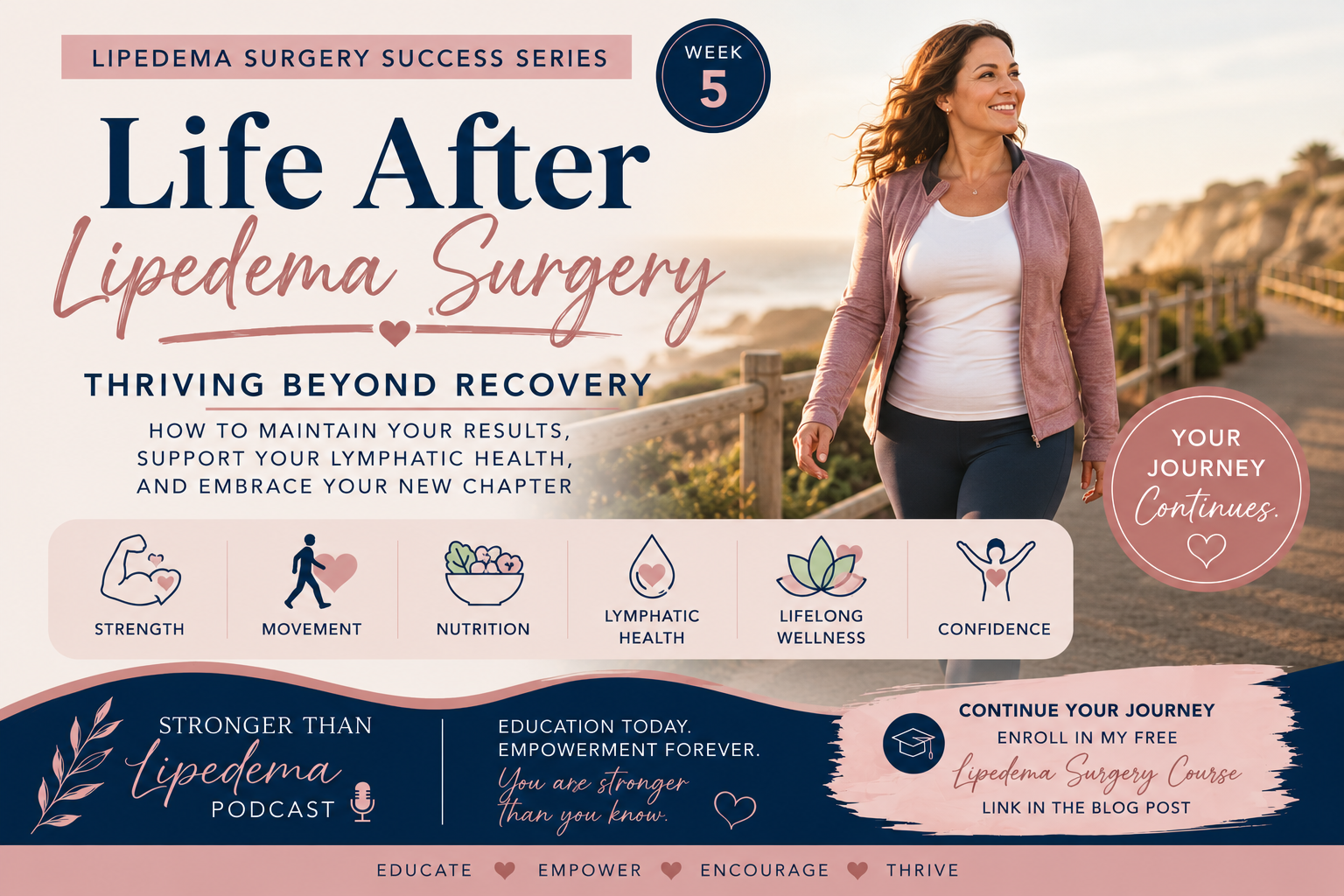
How to Maintain Your Results, Support Your Lymphatic Health, and Embrace Your New Chapter
Part 5 of the Lipedema Surgery Success Series
Congratulations, you’ve made it to the final installment of the Lipedema Surgery Success Series.
Over the past several weeks, we’ve walked through every stage of the surgical journey:
- How to know if you’re ready for surgery
- Choosing the right surgeon
- Preparing for surgery
- What to expect during recovery
Now it’s time to talk about what comes next.
For many women, surgery feels like the finish line. After months, or even years, of researching, planning, saving, traveling, and recovering, it’s natural to think that once you’re healed, your lipedema journey is complete.
But here’s the truth:
Surgery isn’t the end of your journey. It’s the beginning of a new chapter.
While lipedema reduction surgery can dramatically improve pain, mobility, and quality of life, it doesn’t erase the need to care for your body. Instead, surgery gives you an opportunity to build healthier habits, support your lymphatic system, and create a lifestyle that helps you thrive for years to come.
Celebrate How Far You’ve Come
Take a moment to appreciate everything you’ve accomplished.
Maybe you’re walking farther than you could before surgery.
Perhaps getting dressed no longer feels like a struggle.
Maybe your legs feel lighter, your pain has decreased, or you’re enjoying activities you once avoided.
These victories matter.
Too often, we focus on what still needs improvement and forget to celebrate the progress we’ve already made.
Healing isn’t just about changing your body, it’s about reclaiming your life.
Surgery Is a Tool: Not a Cure
One of the biggest misconceptions about lipedema surgery is that it “fixes” lipedema forever.
While surgery removes abnormal lipedema tissue, lipedema is still considered a chronic condition.
That means your long-term success depends on the choices you make after recovery.
Think of surgery as an incredible tool, one that can improve function, reduce pain, and enhance your quality of life, but not one that replaces healthy habits.
The work doesn’t end after surgery.
In many ways, that’s when the real journey begins.
Continue Supporting Your Lymphatic System
Your lymphatic system works every day to help move fluid, support immune function, and maintain tissue health.
Even after surgery, it deserves your attention.
Depending on your individual needs and your healthcare team’s recommendations, supporting your lymphatic health may include:
- Regular physical activity
- Staying well hydrated
- Wearing compression garments when appropriate
- Maintaining a healthy body weight
- Manual Lymphatic Drainage (MLD), if recommended
- Managing inflammation through nutrition and lifestyle
- Prioritizing quality sleep
- Managing stress
You don’t have to do everything perfectly.
Consistency matters far more than perfection.
Movement Is One of the Greatest Gifts You Can Give Yourself
Many women notice that movement becomes easier after surgery.
Walking may feel more comfortable.
Exercise may become less painful.
Activities that once seemed impossible may suddenly feel within reach.
This is your opportunity to rebuild strength and confidence.
Choose movement you enjoy.
That might include:
- Walking
- Swimming
- Strength training
- Cycling
- Pilates
- Yoga
- Water aerobics
- Dancing
The goal isn’t to punish your body.
The goal is to celebrate what it can do.
Nutrition Still Matters
Surgery isn’t a replacement for healthy nutrition.
Your body continues to benefit from foods that support healing, reduce inflammation, and provide the nutrients it needs to function well.
Focus on building sustainable habits:
- Eat adequate protein.
- Choose whole, minimally processed foods when possible.
- Stay hydrated.
- Include healthy fats.
- Enjoy plenty of colorful fruits and vegetables.
- Avoid chasing fad diets or restrictive eating plans.
Remember, nutrition isn’t about perfection.
It’s about nourishing your body for the long term.
Strength Training Can Be a Game Changer
As you’re cleared by your healthcare team, adding strength training can provide tremendous benefits.
Building muscle helps support:
- Joint health
- Functional movement
- Balance
- Bone health
- Metabolic health
- Overall strength and independence
Many women find that after surgery they’re finally able to perform exercises that previously caused discomfort.
Start slowly, work with qualified professionals when needed, and celebrate every milestone.
Compression May Still Have a Role
One of the questions I hear most often is:
“Will I always have to wear compression?”
The answer depends on your individual situation.
Some women continue wearing compression regularly.
Others wear it only during travel, exercise, long workdays, or periods of increased swelling.
Your surgeon and healthcare team can help determine what’s appropriate for your long-term care.
Compression doesn’t represent failure.
It’s simply one more tool available to help support your health.
Continue Learning About Your Body
No one knows your body better than you do.
Pay attention to:
- Changes in swelling
- Pain levels
- Fatigue
- Activity tolerance
- Hormonal changes
- Stress levels
Learning how your body responds allows you to make adjustments before small problems become larger ones.
Knowledge truly is one of your greatest forms of self-care.
Body Image Takes Time
Many women expect that once surgery is complete, they’ll instantly love everything they see in the mirror.
Sometimes that happens.
Sometimes it doesn’t.
Healing emotionally often takes just as long as healing physically.
Your body has carried you through years of pain, frustration, misunderstanding, and now surgery.
Give yourself grace.
Instead of asking:
“Do I look perfect?”
Try asking:
“Can I do more than I could before?”
“Do I feel stronger?”
“Am I living more fully?”
Those answers often matter far more.
You May Still Need Additional Procedures
For some women, lipedema treatment doesn’t end with one surgery.
Depending on your goals and your surgeon’s recommendations, you may eventually consider:
- Additional lipedema reduction procedures
- Skin removal surgery
- Treatment of other affected areas
There is no right or wrong timeline.
Some women pursue additional procedures.
Others decide they’re happy where they are.
Both decisions are valid.
Your Mental Health Matters
Living with lipedema often involves years of misunderstanding, misdiagnosis, and frustration.
Even after surgery, those experiences don’t simply disappear.
If you’re struggling emotionally, know that you’re not alone.
Consider:
- Joining a support group
- Connecting with other women living with lipedema
- Speaking with a mental health professional
- Practicing gratitude and self-compassion
Healing isn’t only physical.
Become Your Own Best Advocate
One of the greatest gifts surgery can give you isn’t simply physical improvement.
It’s confidence.
Confidence to ask questions.
Confidence to seek second opinions.
Confidence to advocate for yourself.
Confidence to educate others.
Confidence to recognize that your symptoms are real and deserving of compassionate care.
Your voice matters.
And your story may encourage another woman who is just beginning her own journey.
What I Wish Every Woman Knew Before She Started This Journey
If I could sit down with every woman who has just been diagnosed with lipedema, this is what I would tell her:
You are not broken.
Your body has not failed you.
You did not cause this disease.
You don’t have to have all the answers today.
Take your time.
Learn as much as you can.
Ask questions.
Find healthcare professionals who listen.
Celebrate progress instead of perfection.
Remember that surgery is just one chapter in a much larger story.
Most importantly…
Don’t let lipedema define who you are.
You are so much more than a diagnosis.
Final Thoughts
This concludes our Lipedema Surgery Success Series, but I hope it marks the beginning of something even greater for you.
Whether you’ve already had surgery, you’re preparing for surgery, or you’re simply exploring your options, remember this:
Your journey isn’t measured by the number of procedures you’ve had.
It’s measured by the life you’re building.
Every healthy meal.
Every walk.
Every strength-training session.
Every moment you choose self-care.
Every question you ask.
Every step you take toward better health.
Those are the things that create lasting change.
Surgery may open the door.
But your daily choices help determine what comes next.
Keep learning.
Keep moving.
Keep advocating.
Keep believing in yourself.
Because thriving isn’t about achieving perfection.
It’s about creating a life where lipedema no longer has the final say.
Continue Your Journey
If you’ve found this series helpful and want additional guidance before, during, or after lipedema surgery, I invite you to enroll in my FREE Lipedema Surgery Course.
Inside the course, you’ll learn:
- How to prepare for surgery with confidence
- What to expect during recovery
- The role of compression, Manual Lymphatic Drainage, movement, and nutrition
- Tips for achieving the best possible long-term outcomes
- How to become an informed advocate for your health
My hope is that this course gives you the knowledge and confidence to navigate your journey with clarity, realistic expectations, and hope.
Thank you for joining me throughout the Lipedema Surgery Success Series.
Here’s to your health.
Here’s to your healing.
And here’s to thriving beyond recovery.
Supporting Your Wellness,
OX, Cindy
Not Sure What Your Next Step Should Be?
You’ve learned a lot about lipedema, but knowing how to put it all together can feel overwhelming. If you’re wondering “What applies to me, and where do I start?”, the Lipedema Roadmap Session can help.
In this private 60-minute Zoom session, we’ll look at where you are in your journey, identify your priorities, and create clear next steps for now, next, and later.
Ready to put the pieces together?
Book Your Lipedema Roadmap Session: https://l.bttr.to/cxLdl
Ready to take your journey to the next level? Join the private Facebook community for exclusive support, practical tips, and a group of women who truly understand. Let’s empower each other to thrive: click here to join! https://www.facebook.com/groups/7021999704562921/
What my FREE checklist: Top 5 Foods to Avoid for Managing Lipedema! Click there Link: https://withcindyhowell.com/checklist/
Looking for personalized guidance to manage lipedema? Work with me one-on-one to create a tailored plan that fits your unique needs and empowers your health journey. Click here to learn more and get started today! https://l.bttr.to/WaDwK
Free Lipedema Surgery Course:https://l.bttr.to/6cATB
Written by Cindy Howell, RN, CLT
Certified Lymphedema Therapist & Lipedema Advocate & Support Coach
This article is for educational purposes and is not a substitute for individualized medical advice. Always follow the instructions provided by your surgeon and healthcare team.