
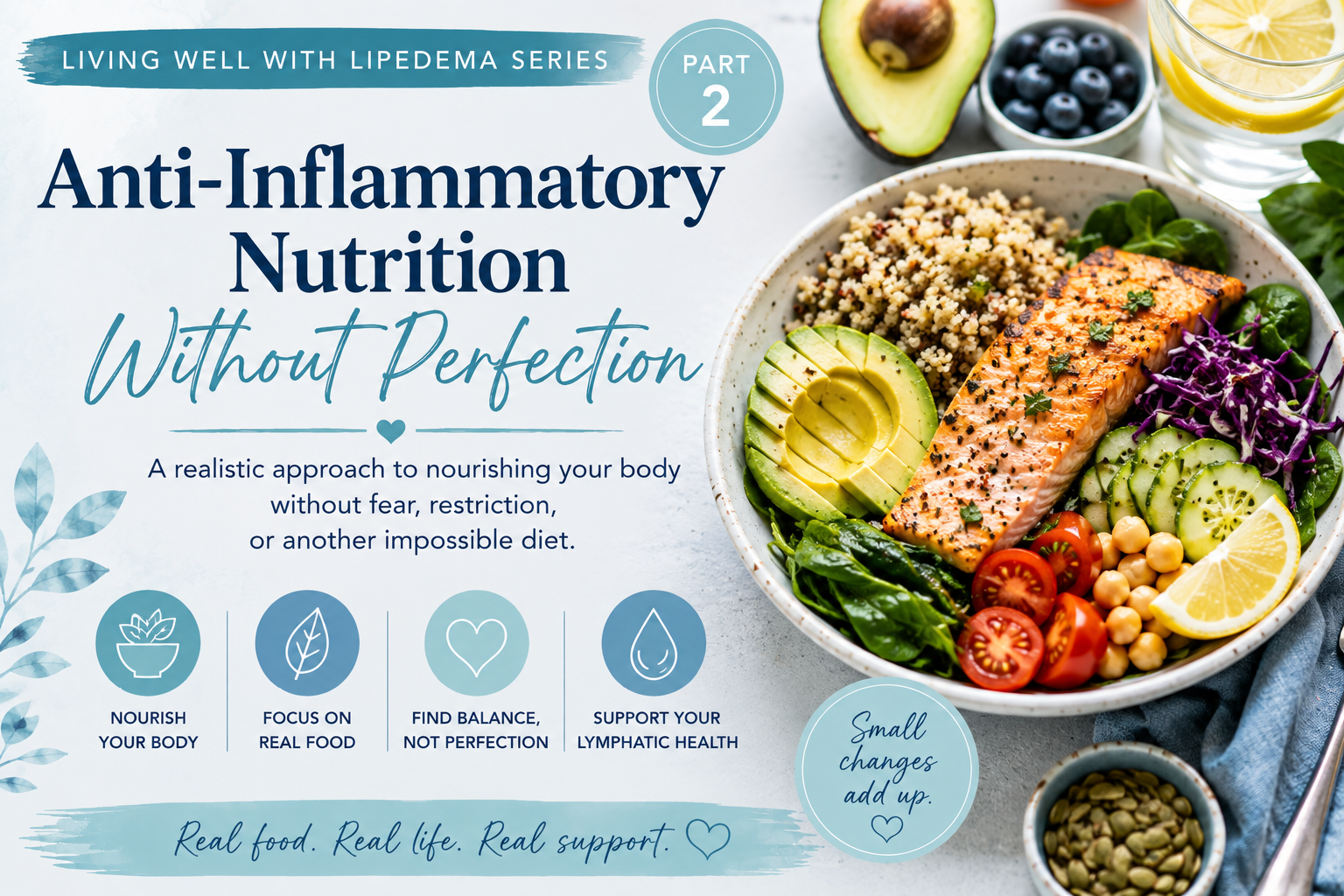
A Realistic Approach to Nourishing Your Body Without Fear, Restriction, or Another Impossible Diet
Part 2 of the Living Well With Lipedema Series
If you have lipedema, chances are you’ve searched:
“What should I eat for lipedema?”
And chances are, you found a LOT of opinions.
Go keto.
Cut carbohydrates.
Eliminate dairy.
Stop eating gluten.
Never eat sugar.
Avoid seed oils.
Follow an anti-inflammatory diet.
Try intermittent fasting.
After a while, it can start to feel like there’s almost nothing left you’re “allowed” to eat.
And that’s exactly where I think we need to change the conversation.
There isn’t one perfect diet for everyone with lipedema, and eating one particular food isn’t going to make or break your health.
Instead of asking:
“What foods do I need to eliminate?”
I want us to start asking:
“How can I nourish my body in a way that supports my overall health and is sustainable for my actual life?”
That’s what we’re talking about today.
First, What Does “Anti-Inflammatory” Actually Mean?
The term anti-inflammatory diet gets used everywhere, but it isn’t one specific diet.
Generally, it describes an overall eating pattern that emphasizes nutrient-dense, minimally processed foods such as vegetables, fruits, lean proteins, healthy fats, whole grains or other fiber-rich carbohydrates, nuts, seeds, herbs, and spices.
At the same time, it tends to limit, not necessarily completely eliminate, highly processed foods, excess added sugars, and foods that don’t make you feel your best.
Notice the word pattern.
One meal doesn’t determine whether your diet is healthy.
One dessert doesn’t suddenly undo everything you’ve done.
What you do consistently matters far more than what you do occasionally.
1. Start With Protein
If you’re wondering where to begin, protein is a great place.
Protein helps maintain muscle, supports tissue repair, and can help meals feel more satisfying.
Instead of completely changing what you eat, look at your existing meals and ask:
“Where’s my protein?”
That might be:
- Eggs
- Chicken or turkey
- Lean beef
- Fish
- Beans or lentils
- Tofu or tempeh
- Greek yogurt or cottage cheese if you tolerate dairy
- A protein shake when convenience matters
You don’t need to eat the same foods every day. The goal is simply to become more intentional about including protein throughout the day.
2. Add Color Before You Start Taking Foods Away
Instead of opening the refrigerator and thinking about everything you’re supposedly not allowed to eat, look for opportunities to add nutritious foods.
Can you add berries to breakfast?
A vegetable to lunch?
A salad with dinner?
An apple with your afternoon snack?
Different-colored fruits and vegetables provide different nutrients, antioxidants, and plant compounds.
And psychologically, there’s a big difference between:
“I can’t have that.”
and
“What could I add to make this meal more nourishing?”
One feels restrictive.
The other creates choices.
3. Choose Healthy Fats
Fat isn’t something we need to fear.
Sources of unsaturated fats can be part of a balanced eating pattern, including:
- Olive oil
- Avocado
- Nuts
- Seeds
- Fatty fish such as salmon
You don’t need to add huge amounts of fat to every meal. It’s simply about choosing nutrient-dense sources as part of an overall balanced diet.
4. Carbohydrates Aren’t Automatically the Enemy
This is an important one.
You may feel better eating fewer carbohydrates. Someone else may do very well including them regularly.
But the word carbohydrate includes everything from lentils and berries to soda and candy.
Those foods aren’t nutritionally equivalent.
Instead of automatically labeling carbohydrates as “bad,” consider their source.
Fiber-rich options such as vegetables, fruit, beans, lentils, and whole grains can provide valuable nutrients.
Your individual needs may differ depending on your health, preferences, blood sugar regulation, activity level, and other factors.
There is room for personalization without turning an entire nutrient category into something to fear.
5. Be Mindful of Added Sugar Without Becoming Afraid of It
Reducing excessive added sugar can be a reasonable health goal.
But that doesn’t mean you can never have birthday cake again.
There’s an enormous difference between regularly consuming large amounts of sugary drinks and ultra-processed snacks and occasionally enjoying dessert with your family.
Food is nutrition.
But food is also culture, celebration, connection, and enjoyment.
A sustainable approach needs room for all of those things.
6. Pay Attention to How YOUR Body Responds
This is where personalization becomes important.
Some women notice they feel different after certain foods. Others don’t.
Instead of eliminating five food groups because someone on social media told you to, become curious about your own body.
Pay attention to:
How do I feel after eating this?
Do you notice changes in energy, digestion, hunger, or how your body feels?
If you consistently notice a pattern, that’s useful information to discuss with your healthcare provider or a registered dietitian.
Your body can give you information.
But that doesn’t mean someone else’s food rules need to become yours.
7. Stop Chasing the “Perfect” Lipedema Diet
If you’ve tried diet after diet throughout your life, this may be the most important part of this article.
You don’t have to eat perfectly to care for your body.
You don’t have to eliminate every processed food.
You don’t have to bring your own meal to every social event.
And you don’t have to feel guilty because you ate something that wasn’t on someone’s “approved lipedema foods” list.
A way of eating that makes you miserable probably isn’t going to be sustainable.
Instead, aim for consistency over perfection.
Most of the time, choose foods that nourish you.
Sometimes, choose foods simply because you enjoy them.
Then move on with your life.
What Could This Look Like in Real Life?
Anti-inflammatory eating doesn’t have to require expensive supplements, specialty foods, or hours of meal prep.
A day might look as simple as:
Breakfast: Eggs with vegetables and fruit
Lunch: Chicken or beans over a large salad with olive oil-based dressing
Snack: Apple with nuts or another protein-rich option
Dinner: Lean protein, roasted vegetables, and a fiber-rich carbohydrate you enjoy
And yes, there can still be room for dessert.
The goal isn’t to recreate this exact menu.
The point is that healthy eating can be surprisingly simple.
Protein.
Plants.
Healthy fats.
Fiber-rich foods.
Water.
And flexibility.
Try the 80/20 Mindset—Not an 80/20 Rule
You may have heard people talk about eating well “80% of the time.”
I don’t want you calculating percentages or keeping score.
Think of it simply as a mindset:
Let nutritious choices make up the foundation of how you eat while leaving room for real life.
Vacations happen.
Birthdays happen.
Restaurants happen.
Holidays happen.
Your grandchildren may want ice cream with you.
Living well means your nutrition supports your life.
Your life shouldn’t revolve around your nutrition.
Your Challenge This Week
Just like Part 1, I’m not going to ask you to overhaul everything.
Choose one thing to ADD this week.
Maybe it’s:
Adding protein to breakfast.
Adding one vegetable to dinner.
Drinking water instead of one sugary beverage.
Adding berries to your breakfast.
Preparing one meal at home instead of ordering out.
That’s it.
Do it consistently and see how it feels.
Then build from there.
Not Sure What Nutrition Advice Actually Applies to You?
One of the hardest things about lipedema is sorting through conflicting information.
You can read one article telling you to eliminate carbohydrates and another telling you to eat whole grains. One person swears by keto. Someone else says plant-based eating changed her life.
So what should you do?
There isn’t one answer that applies to everyone.
If you’re overwhelmed by lipedema information and aren’t sure what your priorities or next steps should be, my Lipedema Roadmap Session is a one-on-one consultation designed to help you sort through the noise and create a clearer path forward.
It’s not a personalized medical nutrition plan or a substitute for working with a registered dietitian.
Instead, we’ll look at your overall lipedema journey, your questions, the resources you may need, and where it makes sense to focus next.
Ready for a clearer path forward? Book your Lipedema Roadmap Session.
Coming Next: Exercise With Lipedema
In Part 3 of the Living Well With Lipedema Series, we’re going to tackle another topic that can carry years of frustration:
Exercise.
We’ll talk about movement, strength training, lymphatic health, and how to build an exercise routine without using movement as punishment for your body.
Because the goal of this series isn’t to teach you how to live a “perfect” life with lipedema.
It’s to help you build a life that is healthy, sustainable, enjoyable, and yours.
Supporting Your Wellness,
OX, Cindy
Not Sure What Your Next Step Should Be?
You’ve learned a lot about lipedema, but knowing how to put it all together can feel overwhelming. If you’re wondering “What applies to me, and where do I start?”, the Lipedema Roadmap Session can help.
In this private 60-minute Zoom session, we’ll look at where you are in your journey, identify your priorities, and create clear next steps for now, next, and later.
Ready to put the pieces together?
Book Your Lipedema Roadmap Session: https://l.bttr.to/cxLdl
Ready to take your journey to the next level? Join the private Facebook community for exclusive support, practical tips, and a group of women who truly understand. Let’s empower each other to thrive: click here to join! https://www.facebook.com/groups/7021999704562921/
What my FREE checklist: Top 5 Foods to Avoid for Managing Lipedema! Click there Link: https://withcindyhowell.com/checklist/
Looking for personalized guidance to manage lipedema? Work with me one-on-one to create a tailored plan that fits your unique needs and empowers your health journey. Click here to learn more and get started today! https://l.bttr.to/WaDwK
Free Lipedema Surgery Course:https://l.bttr.to/6cATB
Written by Cindy Howell, RN, CLT
Certified Lymphedema Therapist & Lipedema Advocate & Support Coach
This article is for educational purposes only and is not intended to diagnose or treat a medical condition or provide individualized nutrition advice.